Be a reader. Be a writer. Be a communicator.
At St Aelred’s Catholic Primary School, our English Curriculum enables children to develop skills in reading, writing and speaking and listening in a robust, engaging and responsive way. We endeavour to instil a love of reading, writing and language which will last our children a lifetime, allow them to progress in their learning journey and empower them to become confident learners, encourage independence, build self-esteem and acquire a love of learning.
Writing
At St. Aelred’s, we believe in the connectedness of vocabulary instruction, reading, transcriptional fluency and subject specific knowledge to writing. If pupils are able to draw upon a bank of words, knowledge and writing conventions, cognitive space is left for pupils to focus on the content of their writing. The writing curriculum we offer our children will allow them to obtain skills and confidence that will enable them to continue to reach their potential once they leave us.
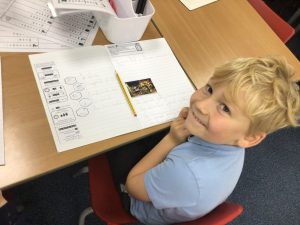
The programmes of study for writing at St Aelred’s are constructed similarly to those for reading: oracy, transcription (spelling and handwriting) composition (articulating ideas and structuring them in speech and writing).
Our writing often uses our wider curriculum sequences of learning as a stimulus for writing, meaning new vocabulary and knowledge is recycled and reused in writing sessions, meaning sessions can have an explicit grammar or text convention focus.
Our writing modules are progressive and sequential with clear end points, thus giving children a deeper experience of vocabulary, modelled published writing and grammatical features and components. At St Aelred’s, we plan to support children in their grammar application and sentence composition. This is taught at the start of the academic year to those children who require it, this is taught to build strong foundations for great writing opportunities.
Spellings
At St Aelred’s we teach our children a systematic and progressive approach to spelling. The principles of the teaching of spellings is based on the spelling concept, pattern seeking, explicit teaching, systematic revisiting and application to writing. The lesson structure is as follows: Depth word study, sentence level dictation and reasoning and self-correction within writing. We want our children to be confident, accurate and ambitious spellers.
Reading
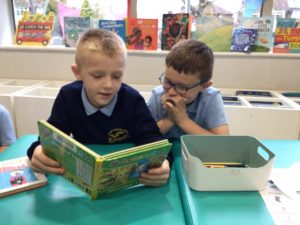
At St Aelred’s, reading is highly valued and promoted to be enjoyed and as an essential life skill. Children are encouraged to become confident, fluent and enthusiastic readers. We want every child to be a reader, giving them the ability and skills to access learning across the curriculum, use reading competently and confidently in their everyday life, as well as grow a love for reading and all of the opportunities that come with it.
We also recognise the importance and impact that reading widely and choosing quality texts, allows children to develop a lifelong love of reading. We strongly advocate, promote and support our children to become lifelong readers.
Our teachers love read to our children and we recognise the importance of the teacher as an inspirational role model.
Teaching a child to read is the greatest gift that we can give a child in our school. Because of this, we see it as a primary purpose of our curriculum. From Early Years to Year 6, we ensure that our children not only learn the skills and knowledge to enable them to read, but also to develop positive life-long dispositions and attitudes towards reading – that will take our children through secondary school and into adulthood.
Teaching children to ‘decode’ or ‘read’ in its most basic form is a key driver for our Early Years and Key Stage 1 curriculum. Once children can ‘read’, through a robust and systematic approach, the world opens up to them. It is our duty to ensure that our children are ready to embrace both the literary and wider world. We use the ‘Little Wandle Letters and Sounds Revised’ scheme of learning to deliver our phonics teaching in our school; we have had extensive support from the regional ‘English Hub’ to ensure best practice is seen in this vital aspect of our work.
More information on the ‘Little Wandle Letters and Sounds Revised’ scheme for parents can be found here.
We know that reading at home is equally as important as reading in school. We want our children to have access to high quality texts whenever they read. With this as our inspiration, all children in KS1 are provided with a Big Cat reading book to take home and read alongside a library book. Depending on the child’s phonic ability, each child in KS2 is either provided with a Big Cat reading book or a book from the school library. The books provided are fully decodable and are matched with the phonic ability of the reader.
The reading curriculum is deliberately designed to be ambitious and aspirational, ensuring that every child leaves our school as a competent, confident reader. Drawing on the latest research around explicit vocabulary instruction, reading fluency and key comprehension strategies, this curriculum is a synthesis of what we know works in helping children make outstanding progress in reading and a distillation into consistent, well-structured practice. The clear structure and principles ensure that teaching is progressive, challenging and engaging and the rich, diverse literature spine acts as both a mirror so that every child can see themselves in the core texts and as a mirror to engage pupils with experiences beyond their own field of reference.