Be Expressive, Be Curious, Be a Communicator

At St Aelred’s, French is taught weekly throughout Key Stage 2. We feel that exposing children to the French language will foster their curiosity and deepen their understanding of the world. Through a fun and engaging curriculum, we aim to provide the children with the tools to express themselves both orally and in writing by the end of Year 6. This would give our children a strong foundation on which to build a love of other languages and learning as they continue into Secondary School.
Implementation:
In KS2, children are taught in weekly sessions by class teachers using our CUSP French scheme of work.
Listening
From the beginning of the French programme in year 3, children are taught active listening skills, learning to distinguish the different sounds and patterns of a foreign language. The children build their ability from listening to single words and sounds, to beginning to distinguish detail in an unfamiliar story.
Oracy
Throughout the languages curriculum, children are given rich opportunities to rehearse using French to discuss their views, opinions and wider lives. They are given the opportunity to engage in purposeful conversations, for example, buying tickets or describing their homes and families, as well as using language to tell, instruct and gain information. Spoken language activities and practice underpin each activity in the French curriculum and provide children with the confidence to express themselves in another language from their mother tongue.
Vocabulary
Vocabulary forms a key part of our wider curriculum and in French is taught discretely in every lesson. Children begin to build a bank of vocabulary throughout their journey through KS2, allowing them to develop more detailed responses and descriptions in their French language work. ‘Vital Vocabulary’ is taught and applied, both verbally and in writing, in every
French lesson.
Impact:
Pupils develop key language learning skills, as set out by the national curriculum, as well as a love of languages and learning about other cultures. These are as follows:
- understand and respond to spoken and written language from a variety of authentic sources
- speak with increasing confidence, fluency and spontaneity, finding ways of communicating what they want to say, including through discussion and asking questions, and continually improving the accuracy of their pronunciation and intonation
- can write at varying length, for different purposes and audiences, using the variety of grammatical structures that they have learnt discover and develop an appreciation of a range of writing in the language studied.
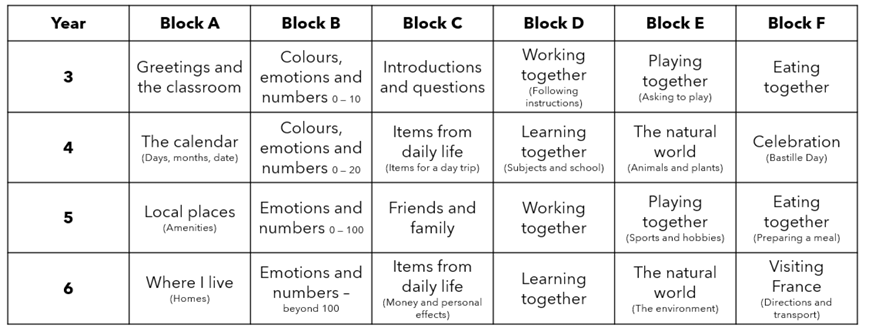
You can see our Long term plan for French below.